The One-Person Company Era: Why AI Makes Teams Optional (Not Better)
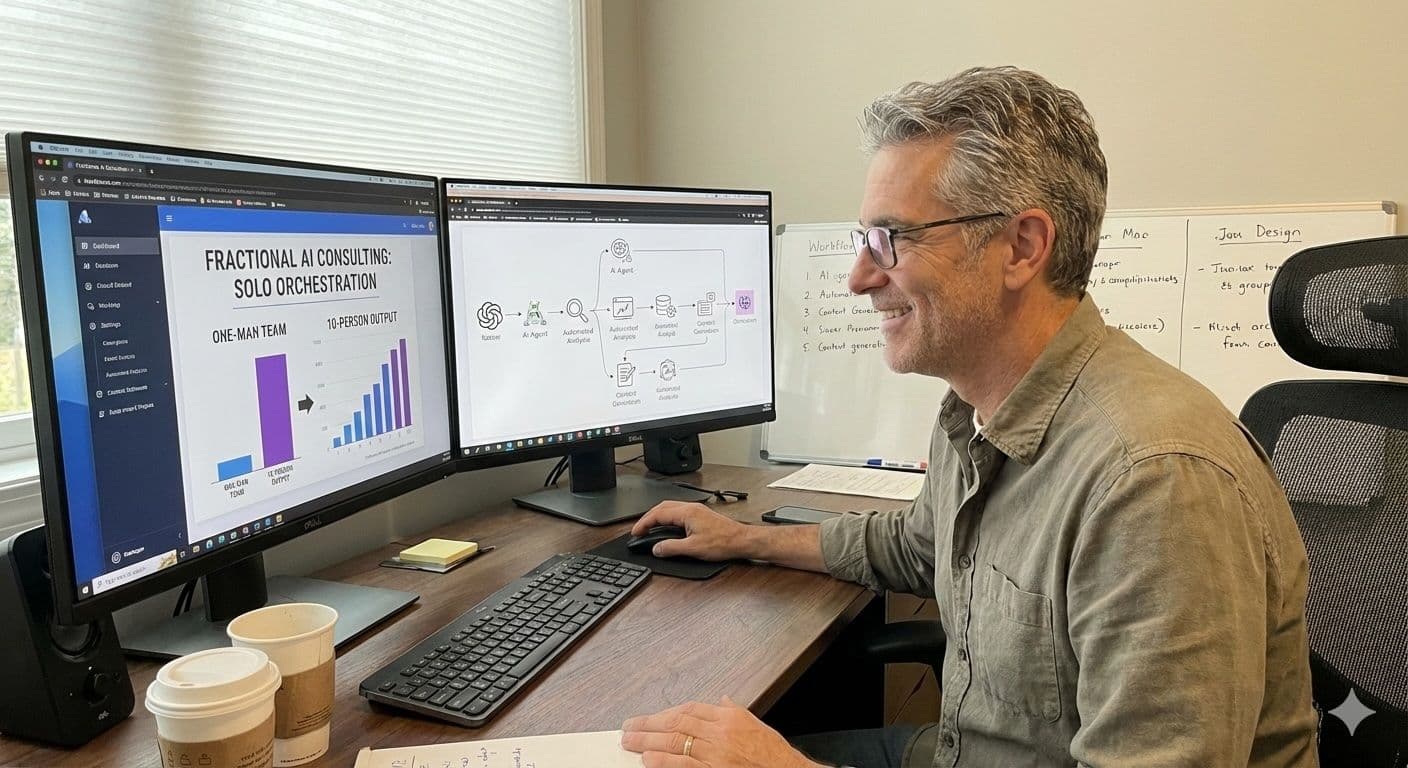
One person can now do what 10 used to. Most executives don't see it coming.
The One-Person Company Era: Why AI Makes Teams Optional (Not Better)
In the next 12 months, one single person will be able to do what used to require a team of 10 people.
I'm watching it happen right now with my own eyes.
Solo founders running million-dollar agencies. One designer replacing entire creative departments. Individual developers shipping products that used to need entire development teams.
And most people still don't see it.
Because it doesn't look dramatic.
It looks like a few AI tools here, a few automations there, just a sprinkle of AI assistants.
But if you zoom out, it's massive.
The one-person company is not a motivational concept anymore. It's becoming the default operating model.
And that changes everything.
Because if one person can produce the output of 10 people, the real competition stops being who has the biggest team.
It becomes who has the biggest leverage.
The winners won't be the companies with the most employees. They'll be the people who know how to orchestrate AI like a workforce.
Here's what the one-person company era actually is, why it's coming faster than most people think, what kind of businesses will explode because of it—and the exact skill that separates the people who will win in 2026 from the people who will get overwhelmed.
The Old World Was Built on Labor
For most of modern history, the limiting factor in business was labor.
If you wanted to do more, you needed more people.
More work meant more time, more coordination, more hiring, more meetings, more payroll, more micromanagement.
You could not scale output without scaling headcount.
That's why companies evolved into layers. Specialists. Departments. Managers. Operations. Systems built purely to coordinate humans.
The real work wasn't the work itself—it was getting people aligned enough to do the work together.
And because labor was expensive, the most powerful companies were the ones who could afford the biggest teams.
The advantage wasn't creativity. It was capacity.
Whoever had the most people could produce the most output.
But AI flips this completely.
Because AI doesn't just make people faster. It changes the economics of output.
When an output becomes cheap, the business model built on headcount collapses.
In the old world, headcount was how you increased capacity.
In the new world, the same person can increase capacity just by adding AI workers.
The unit of scale changes from employees to agents.
And that's the foundation of the one-person company.
Why This Era Is Arriving Now
The reason this is happening right now in 2026 is not a single breakthrough.
It's the stacking of three forces that together create a new reality.
Force 1: Models Are Capable Enough to Handle Real Work
Not just random prompts anymore. Tasks that involve context, structure, and multi-step reasoning.
They can write, plan, analyze, summarize, code, design, and execute workflows with fewer mistakes than before.
This isn't experimental anymore. It's production-ready.
Force 2: AI Is Moving from Chat to Action
It's no longer just a box you talk to.
It's becoming something that can click buttons, call APIs, trigger automations, update databases, and operate inside the tools you're using.
That's where the magic happens.
Because the moment AI can take action, it stops being software you use and becomes software that works.
Force 3: The Cost Curve Is Collapsing
The price of intelligence and generation keeps dropping.
In the old world, hiring a smart person was expensive and slow.
In the new world, hiring an AI worker is instant, scalable, and cheap enough that you can run multiple at once.
Put those three together and you get a new capability:
A single human can delegate tasks to AI workers the same way a CEO delegates tasks to a team.
That's what people miss.
It's not just "AI makes you faster."
It's "AI makes you a manager of capacity."
What a One-Person Company Actually Looks Like
When people hear "one-person company," they usually imagine someone doing everything alone.
Yeah, that sounds stressful.
And in the old world it was—because if you tried to run a business alone, you became the bottleneck for everything.
But that's not the case in 2026.
The one-person company is not one person doing all jobs.
It's one operator sitting at the center of a system, while AI handles repetitive, mechanical, and time-consuming tasks.
Let me show you what this looks like in practice.
Real Example: Sarah's Podcast Production Company
Sarah runs a podcast production company.
She takes long-form podcast episodes and turns them into 30 high-retention short clips per week for her clients.
She charges $3,000 per month per client. She has six clients. That's $18,000 a month in revenue.
In the old world, she'd need a team:
- Editors
- Script writers
- Thumbnail designers
- Project managers
In 2026, here's her actual workflow:
- She uploads the raw podcast to an AI transcription tool like Opus Clip
- The AI generates a transcript with timestamps
- She feeds that transcript into a custom GPT that identifies the 10 most valuable clips based on hooks, punchlines, and storytelling structure
- Another AI tool like Descript takes those timestamps and auto-cuts the clips
- A different AI generates captions, suggests thumbnails, and writes platform-specific descriptions
- Sarah reviews the output—takes her 45 minutes—makes tweaks, and ships
Total time per client per week: 2 hours
She's producing what used to require a four-person team, doing it all by herself with AI workers handling 85% of the execution.
The human stays in the loop—but not as a laborer. As a director.
That's the core shift.
The Big Lie People Believe About "AI Business"
There's a dangerous misunderstanding going around right now.
People think the one-person company means anyone can get rich quick with AI.
Sorry to break it to you: That's not true.
AI lowers the cost of production, but it doesn't remove the need for value.
If output becomes easy, output becomes worthless.
That's the paradox.
When everyone can produce, production stops being the advantage.
So what becomes the advantage?
Direction. Distribution. Taste. Trust. Positioning.
Understanding real customer pain. Knowing what to sell and to whom. Being able to turn AI output into a product people actually want.
AI creates an explosion of supply.
The world is about to be flooded with mediocre products, mediocre content, mediocre services.
And most one-person companies will fail for the same reason startups fail: They build something nobody actually needs.
The winners won't be the ones who generate the most.
They'll be the ones who choose the right problem, package the solution, and deliver outcomes consistently.
Why This Will Destroy a Lot of Small Businesses
Here's the part that sounds harsh, but it's reality.
The one-person company won't just create opportunity. It will also destroy a lot of businesses that were built on low-level labor.
Because there are businesses that only exist because doing certain work used to be annoying, slow, or expensive.
When AI makes that work cheap, these businesses lose their leverage.
Examples:
- Agencies that sell basic content packages
- Companies that sell generic landing pages
- Freelancers who do repetitive admin tasks
- Services that are mostly copy-paste formatting
They don't collapse because AI is evil.
They collapse because the cost of their core deliverable collapses.
The moment clients can get "good enough" output instantly, paying a premium for basic execution stops making sense.
This is why you'll see a strange pattern:
Some businesses will become insanely profitable with fewer people.
At the same time, a lot of service businesses will shrink because their work becomes commoditized.
The middle collapses first.
The average provider gets squeezed.
Only the high-trust specialists and high-outcome operators survive.
The Real Opportunity: Niche + Outcomes
So if output becomes cheap and everyone has tools, what's the winning move?
The winning move is niche with outcomes.
The one-person company that wins is not the one who says "I offer AI services."
That's meaningless. Nobody wants AI specifically. They want results.
Let me show you what this looks like.
Bad positioning:
"I do marketing with AI."
Good positioning:
"I help dental clinics turn Google reviews into 15 booked appointments per month."
That's the difference.
The first one is about tools. Nobody cares.
The second one is about a painful problem for a specific group of people.
Why This Works
Dental clinics get reviews all the time, but most don't have a system to turn a good review into another appointment.
They're leaving money on the table.
You can come in and build a simple workflow:
- AI monitors new reviews
- Triggers a thank-you message with a booking link
- Sends a follow-up sequence to everyone who left a five-star review, asking for referrals
You can charge $2,000 per month per clinic. You can handle 10 clients by yourself.
That's $20K per month as a one-person company.
The One Skill That Separates Winners from Losers
If I had to reduce the one-person company to one single skill, it would be this:
Orchestration.
Not just using AI. Orchestrating AI.
Orchestration means you can take a messy goal and turn it into a system that produces results.
It means you can do three things consistently:
- Break a big goal into smaller steps
- Assign those steps to different AI workers
- Review the output and correct it until it matches your desired outcome
This is what most people miss.
They think this new economy rewards being technical.
It doesn't. It rewards being able to steer.
When everybody can generate, the people who win are the ones who can direct generation toward impact.
They know what good looks like. They can judge quality. They can make tradeoffs. They can make decisions.
The Difference in Practice
Person A:
Asks ChatGPT: "Write me a landing page for my coaching business."
Gets a generic result. Gives up.
Person B:
Breaks it down: "Write me a landing page for executive coaches who help burnt-out VPs transition into consulting. The promise is: Land your first $50K consulting client in 90 days. Tone is direct, experienced, no fluff. Include social proof, a clear CTA, and address the fear of leaving corporate security."
Gets a strong draft. Refines it through 3-5 iterations. Ships it.
Person A uses AI. Person B orchestrates AI.
That's the difference between dabbling and winning.
The Dark Side: Overwhelm and Fake Businesses
This era also has a dark side.
A lot of people will try building one-person companies and fail miserably.
Not because they're not talented, but because AI creates the illusion of progress.
AI makes it easy to generate plans, content, websites, offers, brand identities.
That can feel like work. It can feel like building.
But it's not actual building unless it reaches customers and creates value.
The Failure Mode
You generate for weeks. You polish. You perfect the landing page. You create a thousand pieces of content. You build the automation. You design the brand.
You feel really productive.
But nobody buys.
Because the missing piece was demand. Real demand.
That's the boring part. The part no one wants to do:
- Talk to customers
- Validate their pain
- Understand what people already pay for
The one-person company rewards output. It punishes delusion.
How a One-Person Company Beats a 10-Person Company
Here's a crazy thought that's becoming true:
A one-person company can beat a 10-person company—not because it's smarter, but because it's faster and more focused.
Big teams have friction:
- Coordination costs
- Meetings, approvals, communication overhead
- Misalignment
- Slow decision-making
- Politics
A one-person company has almost none of that.
One decision maker. One direction. One set of priorities. One owner of outcomes.
AI eliminates the execution bottleneck.
That's why the small company no longer loses because it can't produce.
It only loses if it can't decide.
Head-to-Head Scenario
A 10-person marketing agency gets a request:
"We need a new positioning strategy and content plan for our product launch in 2 weeks."
Agency's process:
- Monday: Kickoff meeting with team
- Tuesday-Wednesday: Research and brainstorming
- Thursday: Draft review with internal stakeholders
- Friday: Revisions
- Next Monday: Client presentation
- Timeline: 7+ days
- Price: $8,000
One-person company's process:
- Client sends request
- Operator spends 2 hours using AI to research competitors, analyze market positioning, generate three strategic options with content calendars
- Reviews output, refines best option
- Delivers same day or next day
- Timeline: 1 day
- Price: $3,000
The client gets the same outcome, faster and cheaper.
The advantage becomes speed, decision, and clarity.
In the AI era, speed doesn't mean typing fast. It means decision speed.
The one-person company can decide everything faster than the 10-person company.
That's why tiny operators will win now more than ever.
The Playbook: Building Your One-Person Company
If you want to win in this era, here's your playbook.
Step 1: Pick a Narrow Problem People Already Pay to Solve
Don't choose something vague like "AI automation."
Choose a painful bottleneck with a clear outcome.
How to find validated demand:
- Go to Upwork or Fiverr
- Search for services priced at $500+
- Look at who has the most completed jobs
- That's validated demand
- Ask yourself: Can AI do 80% of this?
Step 2: Build a Delivery System Using AI
Do not sell effort. Sell a result.
Test it on yourself or a pilot client until the output is consistent.
Step 3: Create Proof
In a world with infinite claims, proof becomes the only currency.
- Record a Loom video showing before and after
- Screenshot the results
- Get a testimonial
- Make it undeniable
Step 4: Build Distribution
AI makes production cheap. That's why attention becomes the bottleneck.
Pick one channel. Go deep. Show your work publicly.
Content. Community. Partnerships. SEO. Whatever fits you.
Step 5: Keep the Human Edge Where It Matters
Relationships. Taste. Judgment. Trust. Accountability.
That's what makes you not just another AI wrapper.
Your clients won't hire you because you use AI.
They'll hire you because they trust you with outcomes.
What Nobody Wants to Admit
Here's the uncomfortable truth about the one-person company that nobody wants to admit:
Most people won't do it.
Even though AI removes the execution barrier, it doesn't remove the other barriers:
- Fear of failure
- Fear of looking stupid
- Fear of sales
- Fear of responsibility
- Fear of being alone with your outcomes
The one-person company model gives you all the leverage in the world—but it also gives you all the accountability.
There's no team to blame. No boss to hide behind. No corporate structure to absorb your mistakes.
You own the win the same way you own the loss.
And that level of exposure is terrifying for a lot of people.
They'd rather stay in a job where they can complete tasks, get a paycheck, and avoid the existential weight of "Did I build something people want?"
Here's What Will Actually Happen
AI will make it possible for millions of people to start a one-person company.
But only a small percentage will actually commit.
And an even smaller percentage will make it past 6 months.
Not because AI failed them. Because they failed themselves.
Opportunity without execution is just daydreaming.
The Bottom Line: Will You Use AI or Compete Against People Who Do?
The one-person company era is here.
One person can now do what used to require a team of 10.
The real competition is no longer who has the biggest team. It's who has the biggest leverage.
Solo founders are running million-dollar agencies. Individual designers are replacing entire creative departments. Single developers are shipping products that used to need entire teams.
And most people still don't see it coming.
Because it doesn't look dramatic. It looks like a few AI tools, a few automations, a sprinkle of AI assistants.
But zoom out and it's massive.
The winning formula:
- Niche + outcomes (not "I do AI services")
- Orchestration (not just using AI, but directing it)
- Proof (in a world of infinite claims, proof is currency)
- Decision speed (small beats big because small decides faster)
- The human edge (relationships, trust, judgment, accountability)
The skill that separates winners from losers: Orchestration.
Breaking goals into steps. Assigning steps to AI workers. Reviewing and refining output until it matches your vision.
The dark side: AI creates the illusion of progress. You can generate for weeks and feel productive while building nothing anyone wants.
The uncomfortable truth: Most people won't do this. Not because AI failed them, but because they failed themselves.
The one-person company gives you all the leverage—and all the accountability.
The real question is:
Will you be the person using AI as your workforce, or will you compete against people who do?
This era won't reward the biggest players anymore.
It will reward the best operators.
And if you understand this concept early, you're not late to the future.
You're actually early.
Ready to Build Your AI-Leveraged Executive Career?
The executives winning in 2026 aren't building bigger teams. They're orchestrating AI to deliver 3-10x output as one-person operations.
Book a Strategy Call to discuss how to position yourself for the one-person company era.
Join My Newsletter for daily insights on AI transformation and executive strategy.
Written by
Bill Heilmann