Building Your Backup Plan Without Burning Your Bridge
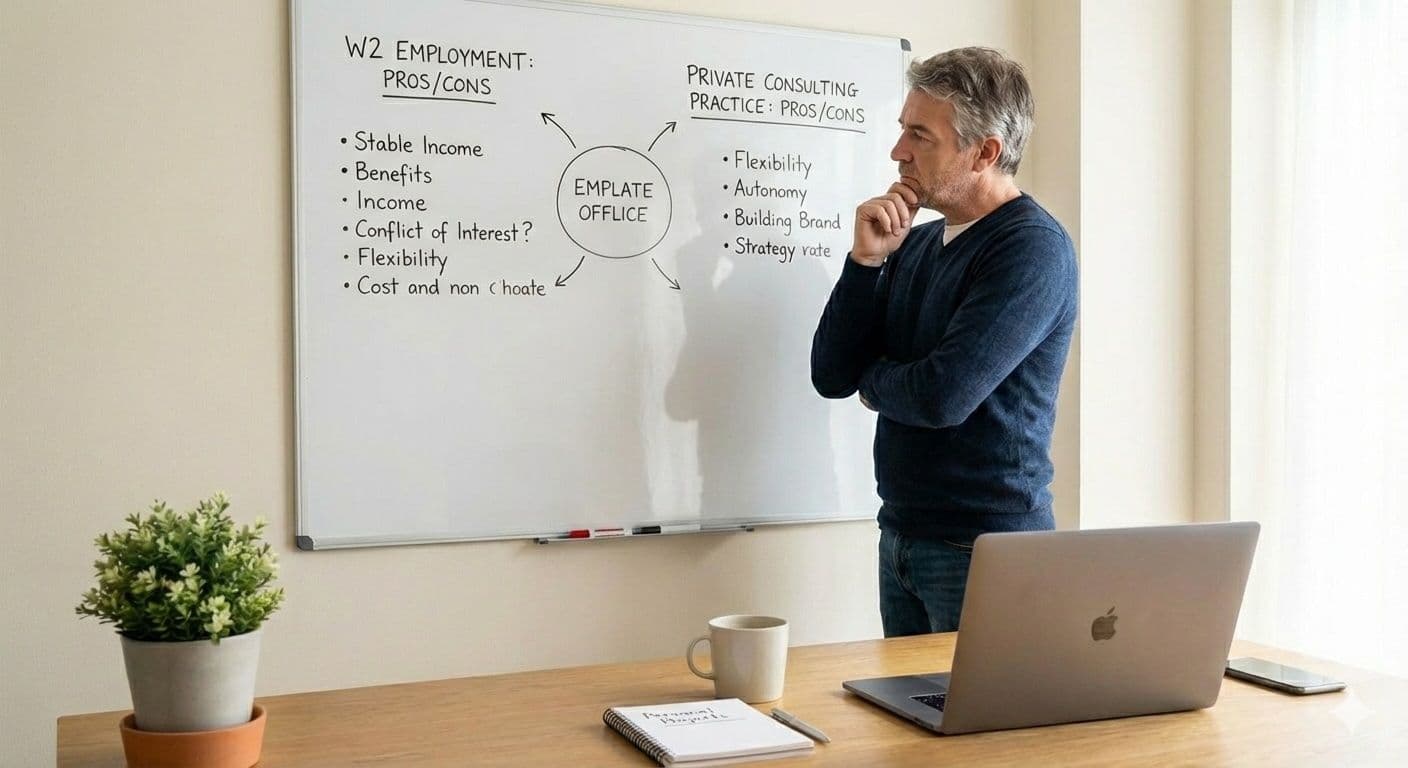
Still employed? How to build your personal brand without a conflict of interest.
Building Your Backup Plan Without Burning Your Bridge
A VP-level executive reached out to me yesterday with a question I've been hearing more often.
He's comfortably employed. Good title, solid comp, RSUs still vesting. No immediate crisis. But he's watching what's happening in his industry — the AI-driven reorgs, the quiet layoffs, the VP and Director roles that simply aren't being backfilled — and he's doing something smart.
He's building.
His own website. An LLC. A newsletter. Some early consulting conversations on the side.
Then he asked me the question that stops most executives before they ever start:
"Bill, how do I do this without it looking like a conflict of interest?"
It's the right question. And most executives never ask it because they're either too afraid to start or too naive to realize the line exists.
Let's talk about where that line actually is — and how to build the right way.
Why Smart Executives Are Building Now
The executives I work with who are 45 to 55 and currently employed fall into two camps.
The first group is waiting. They believe hiring will pick back up, their company is stable enough, and their tenure and relationships will protect them. Some of them are right. Most of them are operating on assumptions that haven't been tested in this market yet.
The second group is building quietly. They're not panicking. They're not rage-posting on LinkedIn about layoffs. They're just doing the slow, deliberate work of making sure they have options — regardless of what their employer decides next quarter.
The difference between these two groups won't be obvious today. It will be obvious in 18 months.
Here's what the builders understand that the waiters don't: visibility compounds. A newsletter you start today has 200 subscribers in six months and 2,000 in two years. A website you build now has domain authority and search traffic by the time you actually need it. A consulting relationship you start casually this year becomes a retainer client when you need one.
The executives who will have real options in 2027 are the ones taking small, consistent steps right now. Not because they're pessimistic about their current job. Because they're serious about their career.
The Real Definition of Conflict of Interest
Before we talk about what's safe, let's be clear about what actually creates a conflict of interest.
A conflict of interest exists when your outside activities directly compete with or harm your employer's business interests. That's the legal and ethical standard — not "anything that looks like I have a life outside this company."
Most executives dramatically overestimate what crosses the line. They assume that having a website, writing about their industry, or doing occasional consulting automatically puts them at risk. It doesn't.
What actually creates exposure:
Using company time. If you're writing your newsletter at 2pm on a Tuesday from your work laptop on the company network, you have a problem. The work you do for yourself needs to happen on your own time, on your own devices.
Targeting company clients. If your employer's clients start showing up as your consulting clients, that's a conflict. Full stop. The line isn't just legal — it's ethical. Don't do it.
Using proprietary information. The insights you've built over 20 years of experience are yours. The specific data, strategies, pricing models, and client details from your current employer are not. Know the difference.
Competing directly in the same market. If you work for a cloud infrastructure company and you start a competing cloud infrastructure consulting firm, you're in dangerous territory regardless of what your employment agreement says.
Violating your employment agreement. Read yours. Seriously. Many executives have never actually read their non-compete, non-solicitation, or moonlighting clauses. Some are broad. Some are narrow. You need to know what you signed.
That's the actual list. Notice what's not on it.
What Is Completely Safe
Writing about your industry is safe. Publishing your perspective on trends, technology, leadership, and market shifts — under your own name, on your own platform — is not a conflict of interest. It's called being a professional.
Building an audience is safe. A newsletter, a LinkedIn following, a podcast — these are personal brand assets. They belong to you. They travel with you. Building them while employed is not just acceptable, it's smart.
Having an LLC is safe. Forming a legal entity for your outside work is not a declaration of war against your employer. It's a standard business practice. Many executives have LLCs they use for speaking fees, advisory work, and consulting that has zero overlap with their day job.
Advisory roles are often safe. Serving on an advisory board for a non-competing company is something many executives do openly. Some employers even encourage it. Check your agreement, disclose if required, and move forward.
Speaking and writing are safe. Conference talks, articles, guest posts, podcast appearances — all of these build your visibility and credibility without touching your employer's business interests.
The pattern here is simple: build in public around your expertise, not around your employer's business.
The Strategy: Build a Parallel Platform
Here's the framework I walk executives through when they want to build while employed.
Step 1: Establish Your Own Domain
Buy your name as a domain. BillHeilmann.com. JaneSmith.com. Whatever your name is, own it. This is your home base — separate from your employer, separate from LinkedIn, separate from any platform that can change its algorithm or shut down your account.
A simple website with a bio, a blog, and a way to contact you is enough to start. You don't need a full coaching practice or consulting firm built out on day one. You just need a place that's yours.
Step 2: Pick One Content Channel and Be Consistent
The executives I see building real visibility aren't doing everything. They're doing one thing consistently.
For most of my clients, that's LinkedIn. They post two to three times a week about industry trends, leadership insights, and their perspective on where their field is heading. No company secrets. No internal drama. Just their professional point of view.
For others it's a newsletter. A biweekly email to 300 people who opted in to hear their thinking. After a year, that list is worth more than most people realize.
Pick one. Do it consistently. Don't try to be everywhere at once.
Step 3: Build Relationships Outside Your Company
The executives who have the most options aren't just well-known inside their current company. They're well-known in their industry.
That means showing up at conferences. Joining industry associations. Having coffee with peers at other companies. Mentoring people earlier in their careers. These relationships don't feel like career insurance when you're building them. They feel like that when you need them.
Step 4: Start One Consulting Conversation
Not a pitch. Not a business development campaign. Just a conversation.
Tell someone in your network — a former colleague, a peer at a non-competing company, a connection from a conference — that you've been thinking about doing some advisory work on the side. See what they say. More often than not, the first consulting opportunity comes from a conversation that started this way.
You don't need a practice built out before you have the conversation. You just need to start the conversation.
Step 5: Document What You Know
Start a private document — a running list of everything you know that isn't proprietary to your employer. Frameworks you've developed. Methodologies you've refined. Approaches that have worked across multiple companies and situations.
This becomes the foundation of your consulting practice, your speaking topics, your newsletter content, and your positioning when you eventually need it. Most executives have far more transferable intellectual property than they realize. Start capturing it now.
The Disclosure Question
Some executives ask me whether they should tell their employer what they're doing.
My general answer: it depends on your culture, your agreement, and your relationship with your manager.
If your employment agreement requires disclosure of outside business activities — and many do — then disclose. Don't hide it. A VP who gets caught doing something they were contractually required to disclose has a much bigger problem than a VP who had a side newsletter.
If your culture is one where executives regularly do advisory work, speak at conferences, and publish under their own names — and many tech companies are exactly this — then you're probably in good shape. Observe what peers at your level are doing and use that as your benchmark.
If you're in a more conservative environment, be more conservative. Not because you're doing anything wrong, but because perception matters and you don't need the distraction.
The goal isn't to hide what you're building. The goal is to build something that stands on its own — something that's clearly yours, clearly professional, and clearly separate from your employer's interests.
The Mindset Shift That Makes This Work
Here's the thing most employed executives miss.
They think of building a parallel platform as a betrayal of their current employer. It's not. It's a sign of professional seriousness.
The executives who are most valuable to their employers are the ones who are visible, credible, and well-connected in their industry. When you publish thoughtful content about where your field is heading, you're not undermining your company — you're adding to its credibility. When you speak at a conference, you're representing the depth of expertise that your employer benefits from every day.
The best employers understand this. The ones who don't — the ones who see any outside visibility as a threat — are also the ones most likely to make arbitrary decisions about your employment when it suits them. Which is exactly why you need a platform that doesn't depend on them.
Your career is a 40-year asset. Your current job is a chapter in it.
Treat it that way.
What This Looks Like in Practice
Let me give you a concrete picture of what the executives doing this right actually look like.
They have a LinkedIn profile that reads like a point of view, not a resume. They post consistently about industry trends — AI, organizational transformation, the future of their function. They get comments from peers, former colleagues, and people they've never met who find the content valuable.
They have a personal website with a short bio and a handful of blog posts. Nothing elaborate. Just enough to establish that they exist professionally outside of their employer's ecosystem.
Some of them have an LLC. Some don't yet. But they're thinking about it.
A few of them have done one or two paid consulting engagements — a few hours of advisory work for a non-competing company, a speaking fee from a conference, a project for a startup that needed senior perspective. Nothing that competes with their employer. Everything that builds their credibility and their network.
None of them are announcing this at work. None of them are hiding it either. They're just doing it — the way serious professionals have always managed their careers.
The Question to Ask Yourself
Here's where I'll leave you.
If your company announced a significant layoff tomorrow — your role eliminated, effective in 90 days — what would you have to work with?
How visible are you outside your company? How strong is your network beyond your current colleagues? How clear is your professional identity to people who don't already know you?
If the honest answer to those questions makes you uncomfortable, that's useful information. Not a reason to panic. A reason to start.
The executives who will navigate the next three years with the most confidence aren't the ones with the best current jobs. They're the ones who built something that belongs to them — regardless of who signs their paycheck.
Start building. Build it right. And build it now.
The Executives Who Win in 2026 Are Already Moving
I've spent months documenting exactly what that looks like — the frameworks, the strategies, and the specific steps senior executives are using to build real options in this market. It's all going into the 2026 AI Revolution Career Guide, releasing soon.
In the meantime, the best next step is a conversation.
Contact Me to discuss your specific situation and get personalized guidance.
Join My Newsletter to be the first to know when it drops.
Written by
Bill Heilmann