The $700 Billion Reason You Can't Wait for Hiring to "Pick Back Up"
The $700 Billion Reason You Can't Wait for Hiring to "Pick Back Up"
The $700 Billion Reason You Can't Wait for Hiring to "Pick Back Up"
Google just announced they're spending $185 billion on AI infrastructure in 2026.
Not because they're reckless with capital. Because the cost of underbuilding is existential.
Last week, AI agents wiped $285 billion off the value of enterprise software stocks in a single day. Not hype. Actual market repricing of how work gets done.
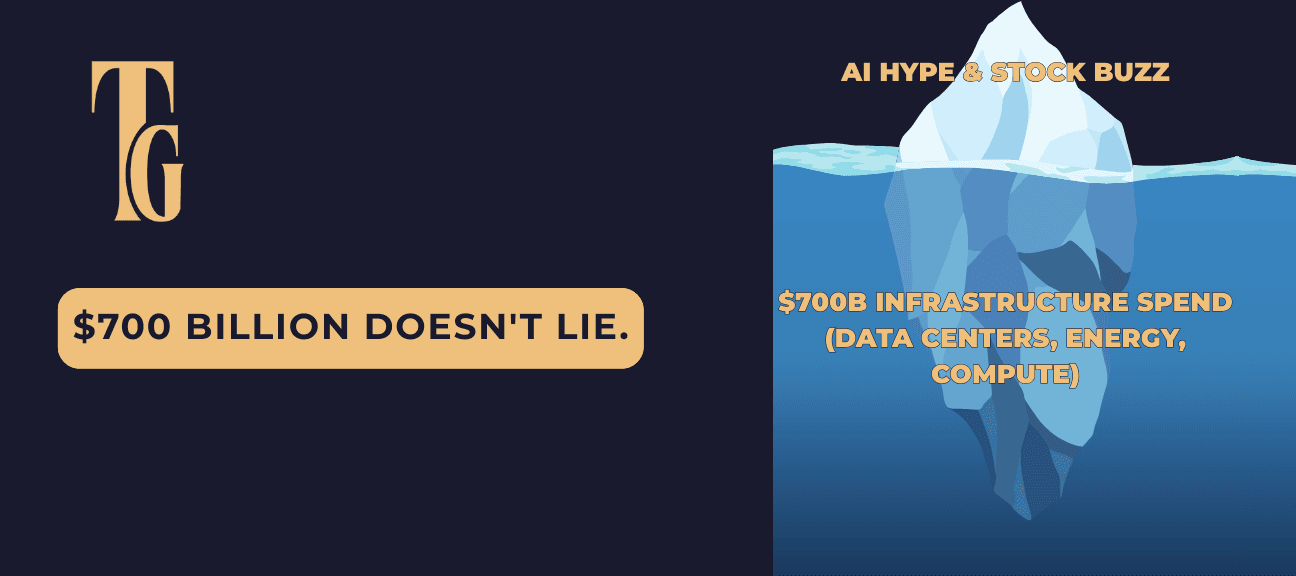
The five largest tech companies will spend $700 billion this year building infrastructure that's fundamentally changing how executives work.
I'm not telling you to quit your job tomorrow and start a consulting practice.
I'm telling you the market isn't "slow." It's structurally different.
Every executive I talk to is waiting for hiring to "pick back up." They think this is a temporary slowdown. They'll ride it out for the next three to five years.
But companies spending $700 billion on AI aren't planning to hire back those Director and VP roles. They're building systems that eliminate them.
You don't need to panic. You need to understand what's actually happening.
The window to prepare isn't two years. It's measured in months.
Here's what the $700 billion in AI infrastructure spending means for your executive career—and why waiting for "normal" hiring to return is the most dangerous thing you can do right now.
The Numbers That Should Wake You Up
Let's start with the scale of what's happening. Because most executives hear "AI investment" and think it's typical tech hype. It's not.
Google: $185 Billion in 2026
Google announced they're spending $185 billion on AI infrastructure this year.
For context:
- That's more than the GDP of Hungary
- It's equal to building 185 new football stadiums
- It's 3.5x what they spent on capital expenditures in 2023
This isn't experimentation. This is commitment.
When a company spends nearly $200 billion on infrastructure, they're not planning to maybe use it someday. They're planning to fundamentally transform how they operate.
The Big Five: $700 Billion Combined
Amazon, Microsoft, Google, Meta, and Oracle combined will spend over $700 billion on AI-related capital expenditures in 2026.
That's billion with a B.
To put this in perspective:
- The entire US venture capital industry invested $170 billion in 2021 (a record year)
- Total corporate R&D spending in the US is around $500 billion annually
- The Marshall Plan (adjusted for inflation) was roughly $150 billion
This is the largest coordinated technology infrastructure build in human history.
And it's happening right now, while executives are "waiting for hiring to pick back up."
The Market Repricing: $285 Billion Wiped Out
Last week, AI agents caused a $285 billion selloff in enterprise software stocks.
What happened:
Companies like Salesforce, ServiceNow, Workday—the backbone of enterprise software—lost massive market value in hours after demonstrations of AI agents performing tasks that used to require their expensive software platforms.
The market looked at AI agents and said:
"If AI can do this work directly, why do we need all this expensive middleware?"
That's not panic. That's repricing based on fundamental shift in how work gets done.
The market is telling us something clear: The future of work doesn't look like the past with slightly better tools. It looks fundamentally different.
What $700 Billion Actually Buys
When you hear "$700 billion in AI infrastructure," what does that actually mean in practical terms?
It Buys Capability That Replaces Headcount
Here's the calculation companies are making:
Traditional approach:
- Hire VP of Marketing at $300K total comp
- Build team of 15 people averaging $120K = $1.8M
- Total annual cost: $2.1M
- Output: Standard marketing function
AI-augmented approach:
- Hire AI-savvy Marketing Director at $180K
- Build team of 6 people averaging $140K = $840K
- AI infrastructure cost: $200K annually
- Total annual cost: $1.22M
- Output: Same or better than 15-person team
Savings: $880K annually
Now multiply that across every function.
Finance. Operations. Customer Success. Product Management. HR. Legal.
That's why they're spending $700 billion. The ROI is immediate and massive.
It Buys Speed That Changes Competitive Dynamics
Here's what AI infrastructure enables:
Software development: What took a team of 10 engineers 3 months now takes 3 engineers 2 weeks with AI-assisted coding
Customer support: What required 50 support reps now requires 8 reps + AI agents handling 85% of inquiries
Financial analysis: What took a team of analysts 2 weeks now takes 1 analyst 3 hours with AI-powered data processing
Content creation: What required a team of 12 writers and designers now requires 3 people orchestrating AI tools
Companies that build this infrastructure move 5-10x faster than competitors.
That's not a nice-to-have. That's existential.
It Buys Insurance Against Being Disrupted
The biggest fear in every boardroom right now:
"What if a competitor builds AI infrastructure and we don't? They'll be able to operate at half our cost with twice our speed. We'll be irrelevant in 18 months."
That's why Google is spending $185 billion.
Not because they know exactly how AI will evolve. Because the cost of being wrong—of underinvesting while competitors pull ahead—is catastrophic.
Every dollar they spend is insurance against obsolescence.
Why "Waiting for Hiring to Pick Back Up" Is a Trap
Here's the conversation I have with executives in job search every single week:
Them: "The market is really slow right now. I'm just going to wait it out. Things will pick back up."
Me: "What makes you think they will?"
Them: "Well, hiring always comes back eventually. This is just a down cycle."
That assumption is catastrophically wrong.
This Isn't a Cycle. It's a Shift.
Traditional hiring cycles:
- Economy slows → Companies cut hiring
- Economy recovers → Companies resume hiring
- Headcount returns to previous levels
What's happening now:
- Economy uncertain → Companies pause hiring
- Companies invest heavily in AI infrastructure
- AI handles work that used to require headcount
- Economy recovers → Companies don't resume hiring at previous levels
The roles aren't coming back.
The Director/VP Layer Is Getting Squeezed
Here's the specific dynamic hitting executives hardest:
C-suite roles: Still needed. You can't AI-replace strategic leadership.
Individual contributor roles: Still needed. Someone has to do the actual work (even if AI-augmented).
Middle management roles (Director/VP): Getting compressed dramatically.
Why?
AI tools are flattening organizations. When individual contributors can be 3-5x more productive with AI, you don't need as many layers of management coordinating their work.
Real example from a tech company I'm tracking:
2023 structure:
- 1 VP of Engineering
- 4 Directors
- 12 Engineering Managers
- 80 Engineers
2026 structure (after AI integration):
- 1 VP of Engineering
- 2 Directors
- 6 Engineering Managers
- 45 Engineers (but outputting more than the previous 80)
They eliminated 2 Director roles and 6 Manager roles.
Those positions aren't "on hold." They're gone. Permanently.
The Three to Five Year Plan Is Fantasy
I hear this constantly: "I'll ride this out for three to five years until things normalize."
Three to five years from now:
- AI capabilities will have advanced exponentially
- Companies will have fully integrated AI into operations
- The executives who adapted early will have 3-5 years of compound learning
- The ones who waited will be unemployable at their previous level
You think the gap between AI-savvy and AI-resistant executives is big now?
Wait until the AI-savvy ones have had five more years of practice.
The executives adapting now aren't just learning today's AI tools. They're building the muscle of continuous adaptation. They're developing AI-augmented workflows. They're becoming 3-5x more productive.
In five years, they'll be unstoppable. And you'll be obsolete.
What Companies Are Actually Doing With AI Infrastructure
Let's get concrete about what this $700 billion is buying and how it's changing hiring.
Use Case 1: AI-Powered Operations
Traditional approach:
VP of Operations oversees:
- 3 Directors (Supply Chain, Logistics, Quality)
- Each Director has 2-3 Managers
- Total team: 25-30 people
- Annual cost: $4-5M
AI-augmented approach:
Director of Operations (not VP) oversees:
- AI agents handling supply chain optimization
- AI agents managing logistics routing
- AI agents monitoring quality metrics
- 2 Managers coordinating AI outputs
- Total team: 8-10 people
- Annual cost: $1.8M + $300K AI infrastructure = $2.1M
Savings: $2-3M annually
The VP role doesn't exist anymore. It's been eliminated by AI infrastructure.
Use Case 2: AI-Driven Customer Success
Traditional approach:
VP of Customer Success oversees:
- 50+ customer success managers
- 15+ support specialists
- 3 Directors managing the teams
- Annual cost: $8-10M
AI-augmented approach:
Director of Customer Success oversees:
- AI agents handling 85% of tier 1 support
- AI agents managing routine customer check-ins
- AI agents identifying expansion opportunities
- 12 high-touch CSMs for strategic accounts
- Total team: 15-18 people
- Annual cost: $3M + $400K AI infrastructure = $3.4M
Savings: $5-6M annually
Again, the VP role is gone. The organization is flatter. AI handles the scale.
Use Case 3: AI-Enhanced Product Development
Traditional approach:
VP of Product oversees:
- 6 Product Managers
- 3 Product Designers
- 2 Product Analysts
- Support from engineering and research
- Annual cost: $3-4M
AI-augmented approach:
Senior Director of Product oversees:
- 3 Product Managers (using AI for research, spec writing, analysis)
- 1 Product Designer (using AI for rapid prototyping)
- AI agents handling user research synthesis
- AI agents monitoring product metrics
- Total team: 5-6 people
- Annual cost: $1.2M + $200K AI infrastructure = $1.4M
Savings: $2M annually
The pattern repeats.
The Window Is Measured in Months, Not Years
Here's the timeline that should terrify you:
Q1 2026 (Now): Infrastructure Build
Companies are spending the $700 billion right now:
- Building AI infrastructure
- Deploying AI agents
- Training teams on AI tools
- Experimenting with AI workflows
Hiring is frozen while they figure out what they actually need.
Q2-Q3 2026: Integration Phase
Companies integrate AI into core operations:
- AI agents handling routine work
- Teams getting more productive with AI
- Managers realizing they need fewer people
- Organizational redesign conversations happening
Hiring stays frozen because they're discovering they need less headcount than before.
Q4 2026: The New Normal
Companies settle into new AI-augmented structure:
- Flatter organizations
- Fewer middle management layers
- Higher productivity per person
- Much lower total headcount
Hiring resumes—but for different roles at different levels than before.
The Director and VP roles that existed in 2023 largely don't come back.
2027: The Adaptation Gap Becomes Unbridgeable
Two types of executives exist:
Type A: Spent 2025-2026 learning AI, adapting their skills, positioning as AI-savvy leaders
- They're getting hired for the new AI-augmented roles
- They're productive and valuable
- They're commanding premium compensation
Type B: Spent 2025-2026 waiting for hiring to "pick back up"
- They're competing for roles that don't exist anymore
- They don't have AI skills the market now requires
- They're unemployable at their previous level
The gap between these two groups is already forming. In 12 months it will be massive.
What the Podcasts and YouTube Videos Are Telling You
I told you to search "AI" on podcasts and YouTube. Here's what you'll find if you actually do it:
Theme 1: The Pace Is Accelerating
Every expert, every CEO, every technologist says the same thing:
"The pace of AI advancement is faster than we expected. What we thought would take 5 years is happening in 18 months."
If the experts building this technology are shocked by the pace, what makes you think you have years to adapt?
Theme 2: White Collar Work Is Most Exposed
The common assumption: "AI will replace blue collar jobs first. White collar knowledge work is safe."
The reality: Complete opposite.
AI is excellent at knowledge work:
- Writing
- Analysis
- Coding
- Research
- Planning
- Coordination
The jobs most exposed are exactly the Director and VP roles executives are waiting to "come back."
Theme 3: The Leverage Shift Is Permanent
Old leverage: Managing large teams -New leverage:* Orchestrating AI agents
What this means:
The executive who can manage 50 people is being replaced by the executive who can orchestrate AI to deliver what 50 people used to.
That's not temporary. That's permanent structural change.
Theme 4: Early Adopters Are Pulling Ahead Fast
Compound learning is brutal:
Month 1 of using AI: Beginner, figuring out basics -Month 6:* Competent, building useful workflows -Month 12:* Proficient, 2-3x more productive -Month 24:* Expert, 5-10x more productive, teaching others
The executives who started 12 months ago already have massive advantages.
The ones starting now can still catch up—but the window is closing.
The ones who wait another year will never catch up.
What You Should Actually Do
Okay, you understand the scale. You get that this is structural, not cyclical. You realize waiting is dangerous.
What do you actually do?
Action 1: Make AI Competency Visible Immediately
Your LinkedIn profile right now probably says:
"Experienced VP of Operations with 15 years leading high-performing teams..."
It should say:
"VP of Operations delivering 3x output through AI-augmented workflows | Transformed operations using AI agents to cut costs 40% while scaling 2x..."
Update your positioning this week.
Not next month. This week.
Every day your profile doesn't mention AI capability, recruiters are passing you over for executives who do.
Action 2: Start Your Daily AI Practice
Not "I'll take a course someday."
Daily engagement:
Every morning, spend 30 minutes using AI tools for real work:
- Use ChatGPT/Claude to draft strategic documents
- Use AI to analyze data or create reports
- Use AI agents to automate routine tasks
- Use AI to research companies or industries
The goal isn't perfection. The goal is building the habit and intuition.
Six months of daily practice creates compound advantage that's impossible to fake.
Action 3: Reframe Your Value Proposition
Stop positioning as:
"I manage teams and deliver results through people"
Start positioning as:
"I deliver results by orchestrating humans + AI to create leverage"
This isn't lying. This is adapting to reality.
If you're not yet orchestrating AI, start now. Then you can honestly position yourself this way within weeks.
Action 4: Target Companies Investing in AI
Don't apply to companies in denial about AI.
Target companies that:
- Are actively investing in AI infrastructure
- Have AI initiatives underway
- Need executives who can integrate AI into operations
- Are building for the future, not clinging to the past
These companies will hire AI-savvy executives even when overall hiring is frozen.
Action 5: Build Your AI-Enhanced 90-Day Plan
When you talk to companies, don't present a traditional 90-day plan.
Present an AI-enhanced plan:
Days 1-30:
- Audit current operations and identify AI automation opportunities
- Implement AI agents for routine tasks
- Train team on AI tools
Days 31-60:
- Deploy AI workflows across function
- Measure productivity improvements
- Refine AI integrations based on results
Days 61-90:
- Demonstrate 2-3x productivity improvement
- Document cost savings from AI implementation
- Plan next phase of AI optimization
This is what companies investing $700 billion want to see.
Action 6: Network With AI-Forward Executives
Stop networking with people who are also waiting for hiring to "pick back up."
Start networking with executives who:
- Are already using AI extensively
- Are landing roles in this market
- Are adapting and thriving
Their strategies are what works now. Learn from them.
The Uncomfortable Truth
Here's what I tell every executive I work with:
The market you're waiting to return doesn't exist anymore.
Companies spending $700 billion on AI infrastructure aren't building for temporary efficiency gains. They're building for permanent organizational transformation.
The Director and VP roles that existed in 2023 are being systematically eliminated.
Not because executives aren't valuable. Because AI-augmented organizational structures require fewer management layers.
Waiting for "normal" to return is the most dangerous thing you can do.
Every month you wait is compound learning you're giving to executives who started adapting 6-12 months ago.
The window to prepare isn't two years. It's measured in months.
The executives positioning themselves as AI-savvy leaders right now will capture the new roles being created. The ones waiting will find themselves competing for roles that don't exist.
You don't need to panic. You need to act.
Start today. Make your AI capability visible. Build your daily practice. Reframe your value proposition. Target AI-forward companies.
The $700 billion being spent this year is rewriting the rules of executive work.
You can either adapt to the new rules—or become obsolete under the old ones.
Your choice.
Ready to Position Yourself for the AI-Augmented Market?
The executives landing roles in 2026 aren't waiting for hiring to "pick back up." They're demonstrating AI-enhanced capability that companies actually need.
Contact Me to discuss how to reposition your executive profile for the AI-augmented market.
Join My Newsletter for daily insights on navigating the AI transformation of executive work.
Get Your Free LinkedIn Assessment to see how your current positioning stacks up in the AI era.
Written by
Bill Heilmann